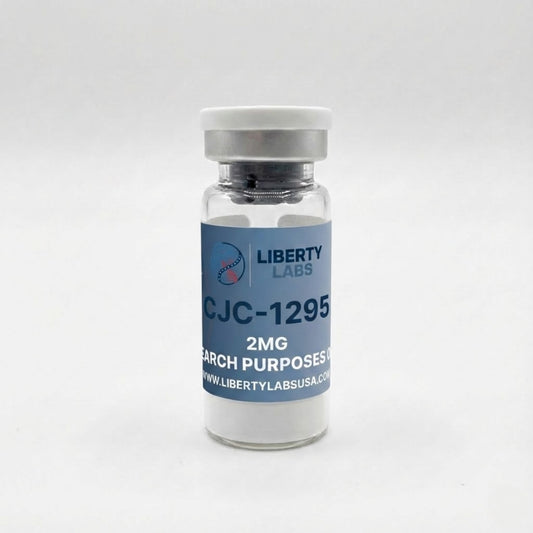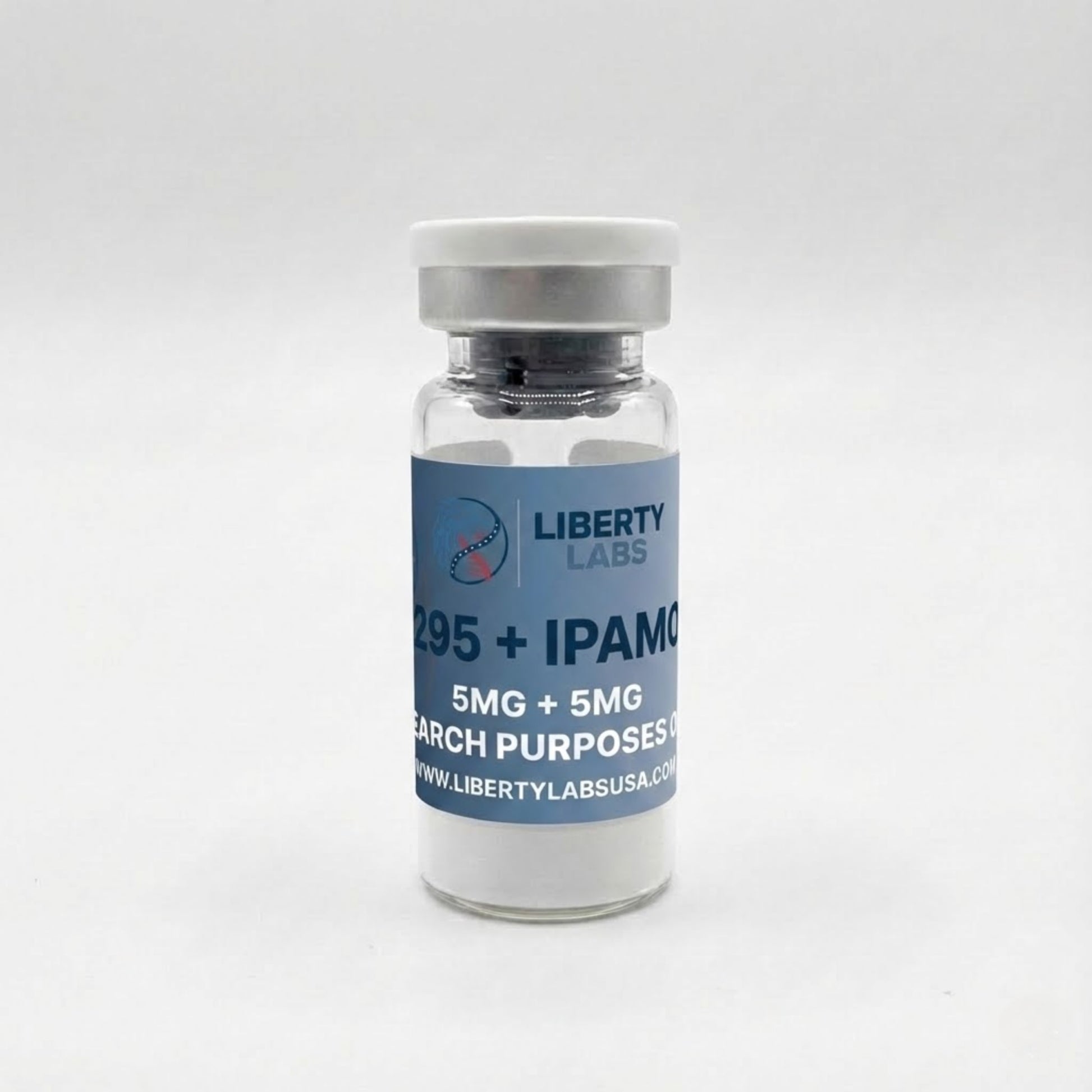
CJC-1295 + IPAMORELIN
CJC-1295 + IPAMORELIN
✔️Form: Sterile Filtered White Lyophilized Powder
✔️Purity: >99% (HPLC Analysis)
✔️Storage: -20°C to 4°C
✔️SKU: CJCIPA-55-LYO
Couldn't load pickup availability
- Free Shipping
- Easy Returns
- Secure Checkout
Chemical Makeup and Sequence
Chemical Makeup and Sequence
Component 1: CJC-1295 (Modified GRF 1-29)
- Molecular Formula: C₁₅₂H₂₅₁N₄₃O₄₃
- Molecular Weight: 3367.9 g/mol
- Synonyms: Mod GRF 1-29,
- Tetrasubstituted GRF (1-29)
Component 2: Ipamorelin
- Molecular Formula: C₃₈H₄₉N₉O₅
- Molecular Weight: 711.85 g/mol
- Synonyms: NNC 26-0161, Aib-His-D-2-Nal-D-Phe-Lys-NH2
Research and Clinical Studies
Research and Clinical Studies
[CJC-1295 + IPAMORELIN] and Synergistic Growth Hormone Release
Research indicates that the concurrent administration of GHRH analogues and ghrelin mimetics results in a "multiplying" effect on GH secretion rather than a simple additive one. In murine and porcine models, subjects receiving co-administration demonstrated GH peak concentrations significantly higher than the sum of individual administrations. Studies suggest this synergy is driven by the recruitment of distinct intracellular signaling pathways—specifically the Protein Kinase A (PKA) pathway by CJC-1295 and the Phospholipase C (PLC) pathway by Ipamorelin—leading to maximal somatotroph activation.
[CJC-1295 + IPAMORELIN] and Protein Synthesis
In vitro and in vivo studies have examined the downstream effects of pulsatile GH release on the Insulin-Like Growth Factor 1 (IGF-1) axis. Elevated serum IGF-1 levels are associated with increased nitrogen retention and protein synthesis in skeletal muscle tissue. In rodent models of muscle wasting, administration of GHRH analogues was observed to attenuate catabolic processes. The combination is hypothesized to support cellular repair mechanisms through the upregulation of mRNA expression for myofibrillar proteins.
[CJC-1295 + IPAMORELIN] and Lipolysis
The metabolic influence of the [CJC-1295 + IPAMORELIN] blend has been evaluated in the context of adipose tissue metabolism. Growth hormone is a known lipolytic agent, promoting the breakdown of triglycerides into free fatty acids. Animal data suggests that sustained pulsatile stimulation of the GH receptor on adipocytes leads to increased hydrolytic activity of hormone-sensitive lipase (HSL). Furthermore, Ipamorelin’s lack of effect on insulin levels in fasting models suggests a pathway for fat oxidation that does not negatively impact glucose homeostasis.
[CJC-1295 + IPAMORELIN] and Sleep Architecture
The role of the GHRH signaling system in sleep regulation is well-documented in academic literature. Intracerebroventricular administration of GHRH analogues in rats has been observed to increase the duration of non-rapid eye movement (NREM) sleep (slow-wave sleep). As the majority of endogenous GH secretion occurs during these deep sleep phases, the exogenous administration of this peptide blend is being investigated for its potential to reinforce natural circadian rhythms and improve sleep efficiency markers in research subjects.
Our Guarantee
Our Guarantee
If you're not 100% satisfied within the first 30 days, just send it back to us and we'll give you a full refund.
No need to worry about the return shipping - we've got you covered!
Shipping Policy
Shipping Policy
We offer fast and reliable shipping on all orders. You can expect to receive it within 7-12 business days based on your location.
Please contact our customer service team for assistance if you have any questions or concerns about your shipment.
Safety and Disclaimers
Safety and Disclaimers
Adverse Effects in Research Models:
In preclinical trials involving rodent and primate subjects, observed side effects included transient vasodilation (flushing) at the injection site and mild water retention (edema) likely mediated by aldosterone modulation, although Ipamorelin is noted for its high selectivity and reduced impact on cortisol and aldosterone compared to other GHRPs. High-dose administration was occasionally associated with transient lethargy in test subjects. No withdrawal symptoms have been characterized in current literature, though hypothalamic desensitization is a theoretical risk with non-pulsatile (continuous) exposure.
Research Use Only Disclaimer:
WARNING! THIS PRODUCT IS SOLD STRICTLY FOR LABORATORY RESEARCH PURPOSES ONLY. This product is not intended for human or animal consumption, therapeutic use, or diagnostic procedures. It is not a dietary supplement, food, drug, or cosmetic. Handling of this chemical should be limited to licensed professionals and researchers equipped with appropriate safety gear. All information provided is for educational and informational purposes only and does not constitute medical advice.

Related Products
-
GLUTATHIONE
Regular price From $37.90Regular priceUnit price per -
 Sold out
CAGRILINTIDE
Regular price From $56.40Regular priceUnit price per -
 Sold out
IPAMORELIN
Regular price From $34.80Regular priceUnit price per -
RETATRUTIDE
Regular price From $49.20Regular priceUnit price per -
 Sold out
SERMORELIN
Regular price From $49.20Regular priceUnit price per -
 Sold out
TESAMORELIN
Regular price From $38.90Regular priceUnit price per -
 Sold out
TIRZEPATIDE
Regular price From $46.10Regular priceUnit price per -
 Sold out
5-AMINO-1MQ
Regular price $76.80Regular priceUnit price per -
 Sold out
ACETIC ACID WATER
Regular price $10.20Regular priceUnit price per -
 Sold out
BACTERIOSTATIC WATER
Regular price $8.20Regular priceUnit price per -
CJC-1295 + IPAMORELIN
Regular price $69.70Regular priceUnit price per